We drove to Monboucher, though the château does not really give itself away from any distance: its beauty only reveals itself once you are close. At the front stands an old oak, and beside it a statue of the Virgin Mary, blessed locally and returned to its place. Together they give the approach the feel of a sanctuary, un sanctuaire de vieilles pierres et de calme, something almost out of an illustration in its oldness, its richness, its calm: the kind of stillness that makes you reconsider how you want to live. Walk round to the back and the character changes entirely. The land opens out into landscape, twenty-three hectares of park framing the pale stone of an eighteenth-century classicist house, built around 1760, that has stood for more than two and a half centuries watching the seasons turn across its grounds.
There is something quietly powerful about arriving at a place like this by car rather than by brochure. Le gravier sous les pneus, le premier aperçu des toits: the sound of the gravel, the first glimpse of the roofs, the gradual withdrawal from the road behind you. All of it is a reminder that culture does not float free of geography. The Dordogne, le Périgord, has always been a region of layered time: prehistoric caves, medieval villages, Renaissance and classical châteaux, and now a living artistic community. Just a short distance away lies Issigeac itself, un village au plan circulaire remarquable, its half-timbered houses still arranged within the memory of its thirteenth-century walls. That circular form feels almost symbolic, a place that holds, that turns inward and outward at once, protecting what matters while remaining open to the world.
Monboucher itself was more surprising inside than out. The historic rooms have not been arranged as a museum to a vanished period; contemporary art interrupts the old architecture, much of it created by people who have spent time at the château. Original features remain alongside a more modern sensibility, and elsewhere the interiors are sparse, almost deliberately so. The old stables, seven hundred and fifty square metres of them, have been turned into what its owners Axel Boesch and Caroline van Boxel call the Ateliers: rehearsal rooms, studio space, somewhere for a choir or a small gym, whatever the moment calls for. Yet the house itself feels lived in: grand, certainly, but also intimate, sometimes eccentric, and unexpectedly cosy, the kind of place in which one immediately understands the temptation to stay for a month and write a book.
Axel described Monboucher as a kind of club, its boundaries deliberately difficult to pin down. ‘Once you’re in, you’re in,’ he told us. But it was another phrase that stayed with us:
That philosophy has a very specific shape behind it. When Axel and Caroline first arrived at Monboucher, the initial task was simply to preserve what was there: the buildings, the park, the character of the place. But the project grew into something else. They were clear early on that they did not want to live alone behind the gates of a large estate, and just as clear that they did not want to run a hotel, with owners on one side and guests on the other. What they have built instead is a small international community of co-owners: people who buy and live in individual residences within the estate, for a season or for years, sharing its park and its cultural life while keeping their own homes and their own privacy. Axel and Caroline intend to live there themselves, among their fellow residents, rather than direct the place from a distance. It is, in other words, exactly the kind of arrangement in which ‘our currency is living’ stops being a slogan and starts being a description.
At Monboucher, the building seems to be understood less as an object to preserve than as a place in which people should continue to make things happen. Those who pass through contribute something of themselves; artists leave work behind; people eat together, work, create, discuss ideas and inhabit rooms that have already contained several centuries of other lives. It felt, in the broadest sense, like an open place in which to explore how living might be done, which made it an unusually appropriate setting for the concert to come, in aid of the Musicians of Tomorrow.
The Academy
We had been invited by British violinist Ishani Bhoola, co-founder and artistic director of the Issigeac International Music Academy (IIMA); we had no prior formal connection, only an introduction and a shared curiosity.
Since 2019, IIMA has quietly gathered musicians from across the world in this corner of France, built on the conviction that young musicians need more than instruction alone. Ishani describes the original ambition as creating an environment in which they could immerse themselves in study, encounter internationally respected artists and teachers and, crucially, perform before paying audiences and begin experiencing the realities of professional musical life. The Academy’s mission reads plainly enough on paper: encourager la créativité, la discipline et l’esprit communautaire, to nurture creativity, discipline and community. In person, though, those words become far less institutional. It is not-for-profit and volunteer-run, rooted in the belief that classical music remains a vital force for cross-cultural exchange, quelque chose que l’histoire multiculturelle de la Dordogne a longtemps compris.
Ishani is warm, friendly and instinctively good with people, but underneath that warmth is considerable drive; ideas arrive continually, whether about musicians to involve, courses to develop, audiences to reach or possibilities for Issigeac. Watching her over the weekend, though, the word that returned most often was not entrepreneur but mentor. There is something almost maternal in the way she takes younger musicians under her wing: she checks on people, encourages them, remembers what is happening in their lives and remains interested long after a course has finished. In her own account of the Academy, supporting a young musician means not merely creating a performance opportunity but continuing to care about that musician’s development afterwards.
On Saturday afternoon, that philosophy moved from the page into the room. Before the concert, Axel and his wife Caroline gathered guests in the hall for an introduction and a tour of Monboucher. The audience was largely French and local to the surrounding area, joined by British and international visitors, Academy supporters and people simply curious about the château itself. There was elegance without ceremony: summer clothes, open doors, people moving easily through the rooms.
And somewhere beneath it came music: a voice warming up, a passage of piano, then conversation again. Late-afternoon sunlight came through the windows and rested across our hands as glasses moved around the room. There was no concert-hall silence, and no rigid division yet between audience and performer: music was already inside the life of the house before anyone had formally taken a seat. It was the first sign of how different the afternoon would feel. We were then ushered into the salon.
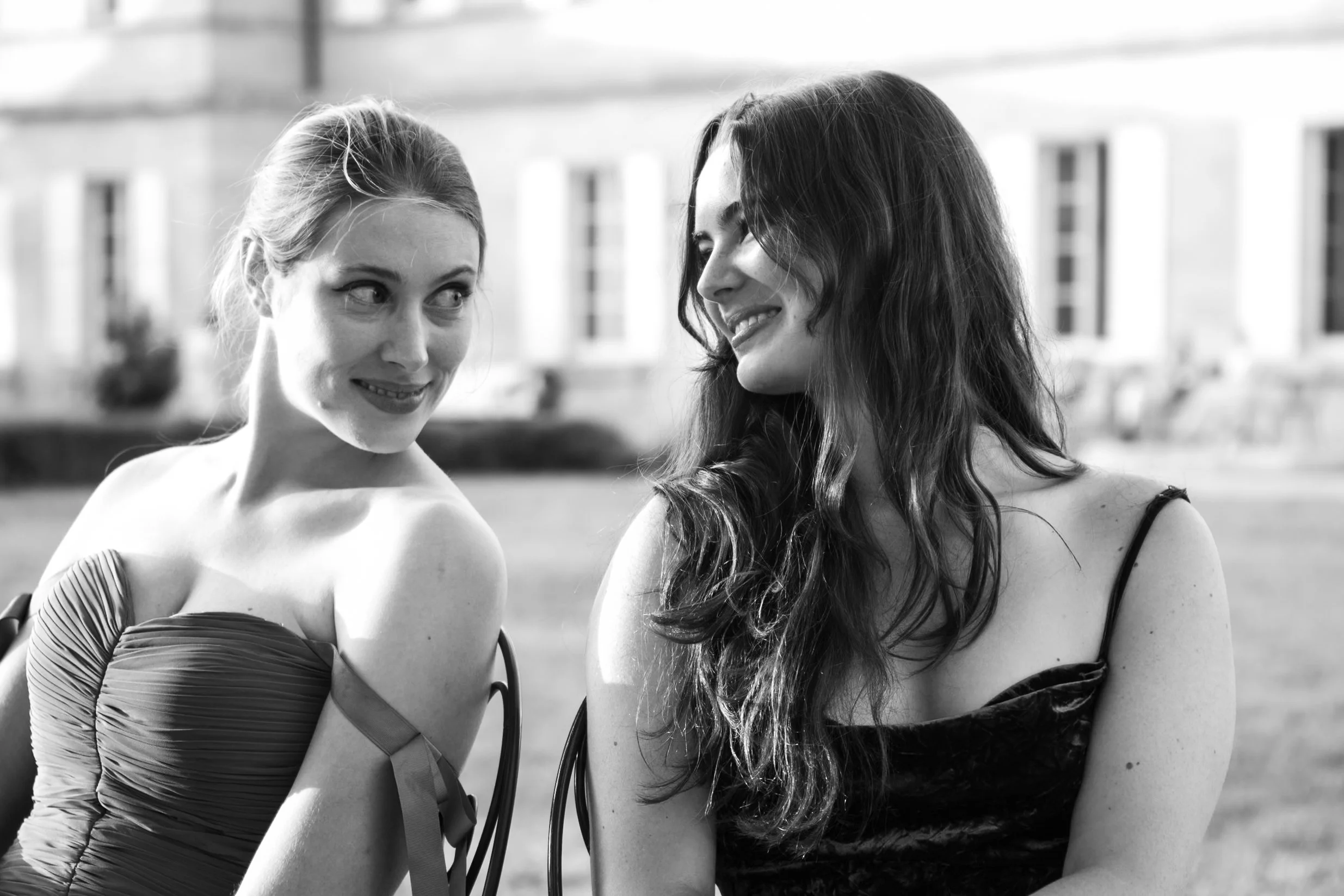
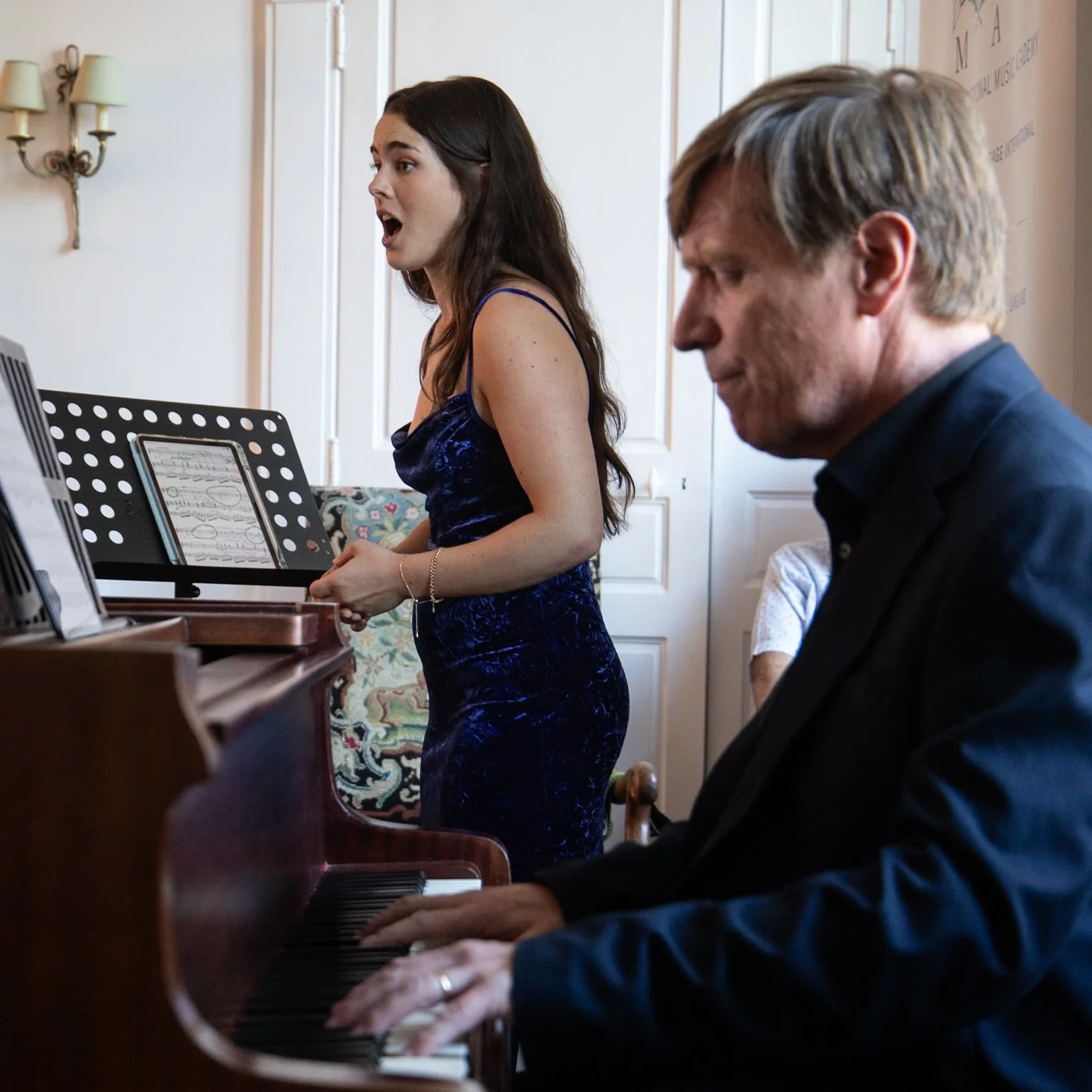
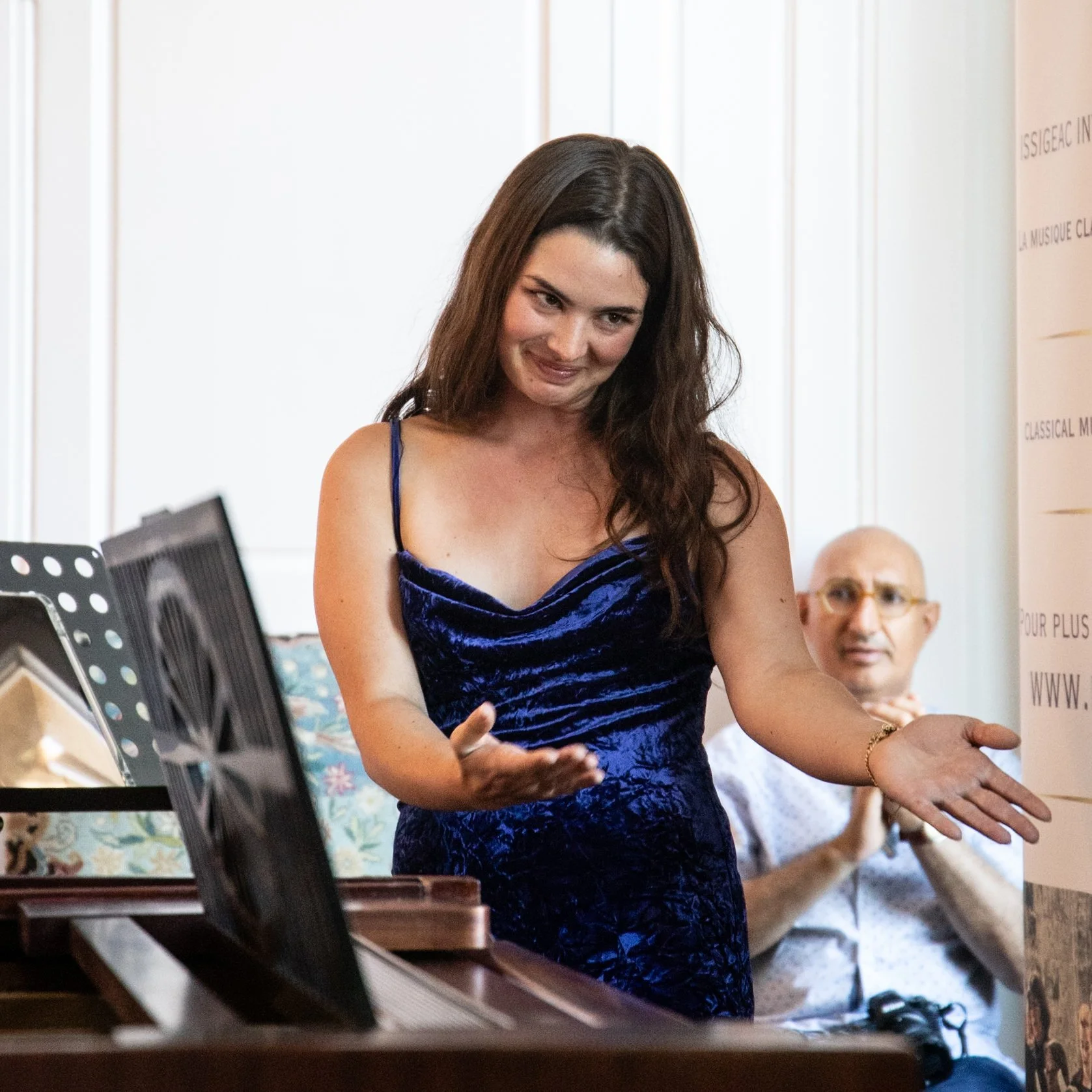
Before the first note: companionship, anticipation and the informal life surrounding performance · Photographs by Stewart Cook
Culture already living here
Among those present was Albert Croce, the language teacher who had first helped connect IIMA with Château de Monboucher. Albert is himself part of the artistic life of the Dordogne: he is the reciter in Duo Apollinaire, an unusual collaboration with mandolinist Wolfgang Scheel in which spoken poetry is brought together with music. Their repertoire ranges across Apollinaire, Verlaine, Baudelaire, Akhmatova and other poets, and the duo has performed repeatedly across the Dordogne, a background that made his role at Monboucher feel especially apt.
He introduced the concert in French with warmth, intelligence and humour; there was laughter in the room, but also evident pride in what the musicians were about to do. His presence mattered because it prevented the Academy from feeling like a cultural enterprise arriving from somewhere else and being temporarily installed in rural France. Here, instead, was a local language teacher whose own artistic life joins words and music, introducing an international classical programme to a largely French audience, in a château whose owners are themselves experimenting with how a historic building might remain culturally alive. Culture was not being brought to the Dordogne; it was already here, meeting something new.
IIMA is explicit about wanting that exchange to work in both directions. Ishani describes it as a French organisation rooted in Issigeac, albeit one with strong British connections and an international outlook: the ambition is not simply to bring British musicians into France, but to build relationships between musicians, audiences and communities across both countries. Albert, standing before us and beginning the afternoon in French, gave that ambition a human scale.
Château de Monboucher · IIMA
Programme of the Evening Programme de la soirée
-
Giacomo Puccini O mio babbino caroElizabeth Zmuda
-
Christoph Willibald Gluck Divinités du StyxAnastasia Ochanina
-
Christoph Willibald Gluck O del mio dolce ardorElizabeth Zmuda
-
Richard Strauss ZueignungAnastasia Ochanina
-
Gabriel Fauré Impromptu No. 2 in F minor, Op. 31Charles Matthews
-
Charles Gounod Je veux vivreElizabeth Zmuda
-
Sergei Rachmaninoff O, ne rydai, moi PaoloAnastasia Ochanina
-
Engelbert Humperdinck Evening Prayer from Hänsel und GretelAnastasia Ochanina
& Elizabeth Zmuda -
Camille Saint-Saëns Valse CanarioteCharles Matthews
-
Franz Lehár Meine Lippen, sie küssen so heißAnastasia Ochanina
-
Camille Saint-Saëns Violons dans le soirIshani Bhoola
Elizabeth Zmuda
& Charles Matthews
Less than a metre away
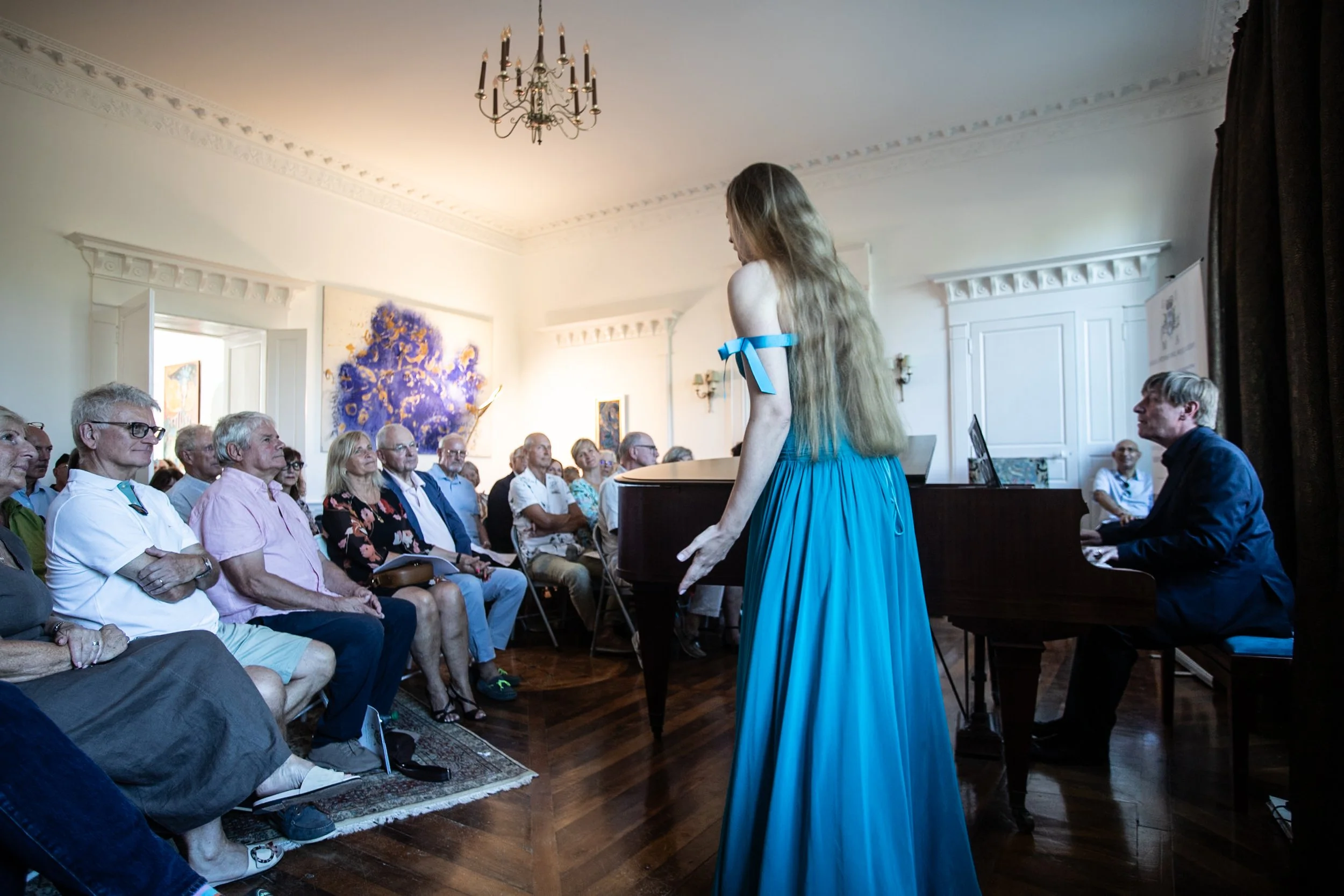
The chairs had been arranged in straight rows with a passage through the centre, allowing the singers to enter through the audience and disappear again into the room behind. We sat towards the left of the front room; the musicians were less than a metre away. It is difficult to explain how dramatically that distance alters classical music. There was no amplification to hide behind, and no great architectural gulf between performer and listener: voice, violin and piano arrived almost in their raw state. The afternoon light remained in the room as the concert began, gradually softening as the programme continued.
Then Elizabeth ‘Lizzie’ Zmuda, from Exeter despite the Polish surname, entered and sang Puccini’s ‘O mio babbino caro.’ The effect was immediate. A trained operatic voice experienced at such close quarters does not simply sound louder; it becomes physical, seeming to enter the body rather than arrive politely at the ear. The sensation was almost involuntary; later, comparing impressions with Albert and fellow travel journalist Lucy Daltroff, we spoke about the hairs rising on our arms. Lizzie has a sensitive, feminine presence that makes the sheer scale of her voice all the more arresting; there is something youthful about her still, not tentative, but open, like an artist at a point where one senses the world beginning to widen around her.
She and Anastasia Ochanina had both attended IIMA’s masterclass programme that past April. At Monboucher they were not being presented as students undertaking an exercise; they had returned as musicians, performing beside established professionals before a new audience, precisely the kind of continuation Ishani sees as central to what the Academy should provide.
Lizzie’s own route to Issigeac was fairly organic. She was a chorister at Exeter Cathedral from an early age, and her mother plays piano; singing, she says, became her life almost before she had a say in the matter, something she always knew she wanted to do and simply had to pursue. She read English and Theatre at Warwick University, where she was president of the Opera Society, though it was by word of mouth, through someone she knew personally rather than through her studies, that she first heard about IIMA. She applied with a video, and it was on the course itself, that April, that she first met Ishani. She describes the experience plainly: ‘genuinely transformative.’ Nelly’s teaching, she says, is personal and direct, delivered now largely online, and focused on concrete technique: naming the devices a singer has available and showing exactly how to use them.
Her own account of her artistic identity is disarmingly candid. She is still figuring it out, she says, and suspects she’ll still be saying that at fifty (hopefully, by then, rather more established). What she does know is that identity is drawn less from the roles she has studied than from life itself: her own experience, her own emotions, the situations she has actually lived through. Right now, she says, her artistic identity is “an extension, and perhaps an exaggerated version, of my real self.”
Purcell has become something of an obsession. She performed The Fairy Queen at St Endellion earlier this summer, and by her own admission he is currently her most-listened-to composer, rivalled only by Lana Del Rey. Having grown up in choirs, she feels permanently drawn to the English choral tradition even as a soloist at heart, which she thinks explains her love of oratorio and Baroque opera. She learns by ear rather than by score, an audio learner, she says, who absorbs music by listening; for all that English pull, though, her favourite language to sing in is Italian.
Storytelling, though, is what she keeps returning to, and that degree shows: she is candidly obsessed with microexpression, body language and the hidden meanings beneath a scene. Because her voice, in her own assessment, has not yet fully matured, she feels a certain ceiling on the purely operatic performances she can currently give, and tries to make up the difference through theatre. But the deeper reason, she says, is simpler: telling stories may be the most human thing we do, and when she performs, what matters most is conveying a character’s internal dialogue.
If Lizzie brought sensitivity and lyricism, Anastasia Ochanina brought something strikingly different. Born and raised in Paris in a Russian family, she grew up listening particularly to Slavic choral music and opera; as a teenager she sang rock and metal with friends, though even then, she says, it came out in a distinctly classical, operatic way: a round sound, a high palate. She began private lessons around the age of sixteen, kept them going alongside school and then university, and after graduating from Université Paris Cité, chose to focus on singing entirely. She now studies at the École Normale de Musique de Paris Alfred Cortot under Maestri Chernov and Toporkova, having first come to IIMA on the recommendation of her own teachers, drawn that April by a masterclass with Nelly Miricioiu, the Romanian-born soprano whose long career in the bel canto repertoire made her one of the most sought-after voices of her generation, and who has since become equally renowned as a teacher. Anastasia speaks of her with plain admiration, and says the way Miricioiu builds the voice shares real common ground with her own training.
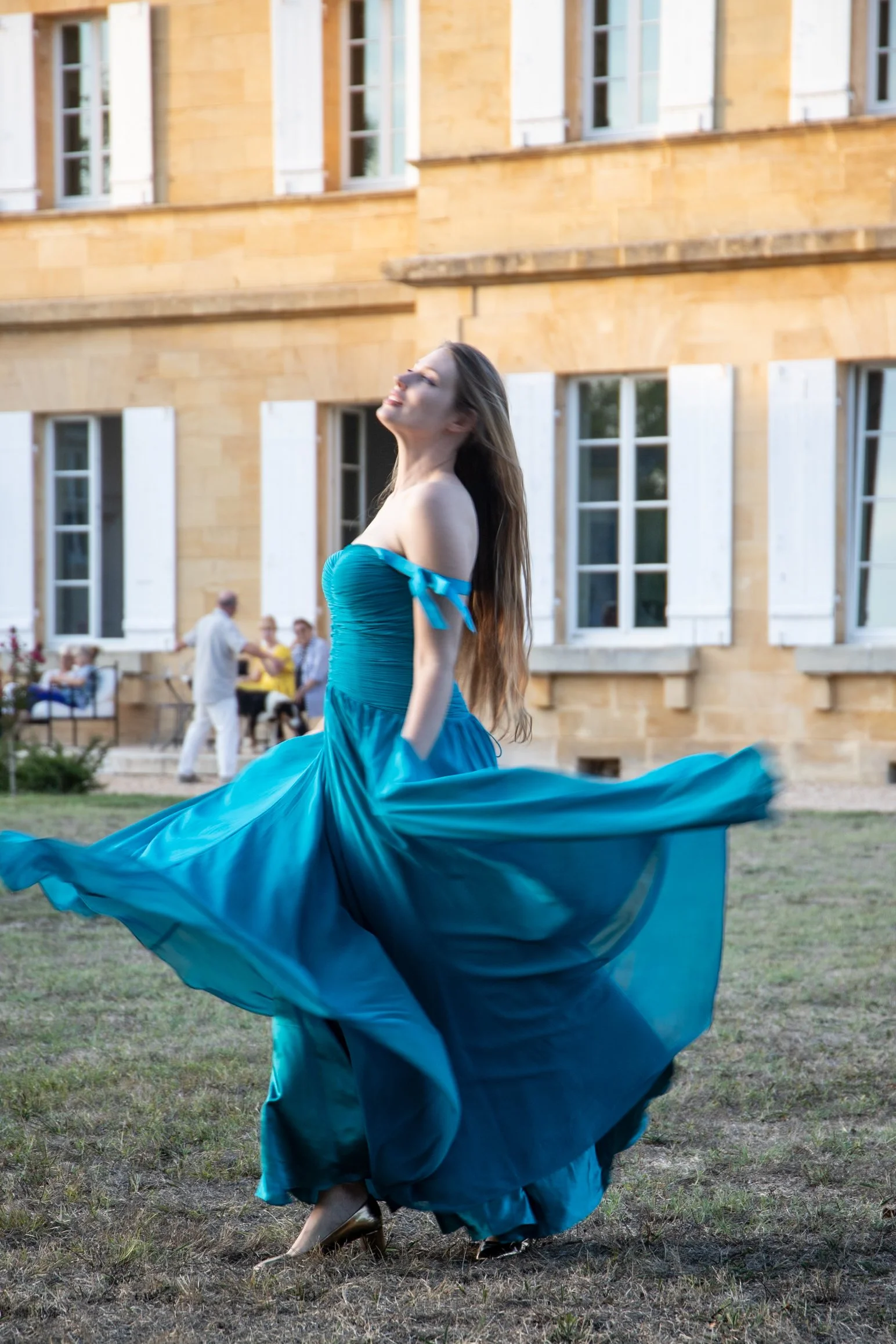
Her stage presence at Monboucher was theatrical, assured and commanding. She does not retreat physically from the drama of what she is singing: expression travels through her whole body, in a sudden movement, a turn of the head, the sweep of long hair and dress, the confidence to make a gesture large enough to reach the character she is inhabiting. Rather than seeming excessive at such close range, it made the distinction between the two young sopranos fascinating: Lizzie drew the listener towards her, while Anastasia seemed capable of taking possession of the room.
Her own understanding of artistic identity makes that physicality easier to place. She is still searching for it, she says, and believes a singer today has to be versatile, a demand that suits her own personality: she can be, in her words, quite different from one moment to the next, and tries to channel different aspects of that identity into whichever character she is inhabiting. Romantic and post-Romantic repertoire speaks particularly strongly to her, including Wagner and Strauss, though she would love to sing Italian repertoire one day, and she is deeply interested in operas rooted in mythology and history: watching how the myths and legends of a people help form their culture, and trying on the shoes of someone from another culture or era entirely. At Monboucher, character was not decoration around her voice; the voice seemed to become another part of the character.
Yet the most revealing thing Anastasia told us had little to do with style: “For me, each step on a stage is about an observation of where I am now and what I need to do next, how I improve as a singer, musician, artist.”
She was pleased by some moments of her performance, she explained, while others would need adjusting for the next. There is something unusually serious in that answer, and it offers perhaps the simplest definition of a Musician of Tomorrow: not an unfinished musician waiting to become worthy of being heard, but a musician already working, performing, judging, correcting and becoming. By late summer, that meant a recital in Venice and further auditions at the École Normale, the next steps already lined up before the applause had properly faded.
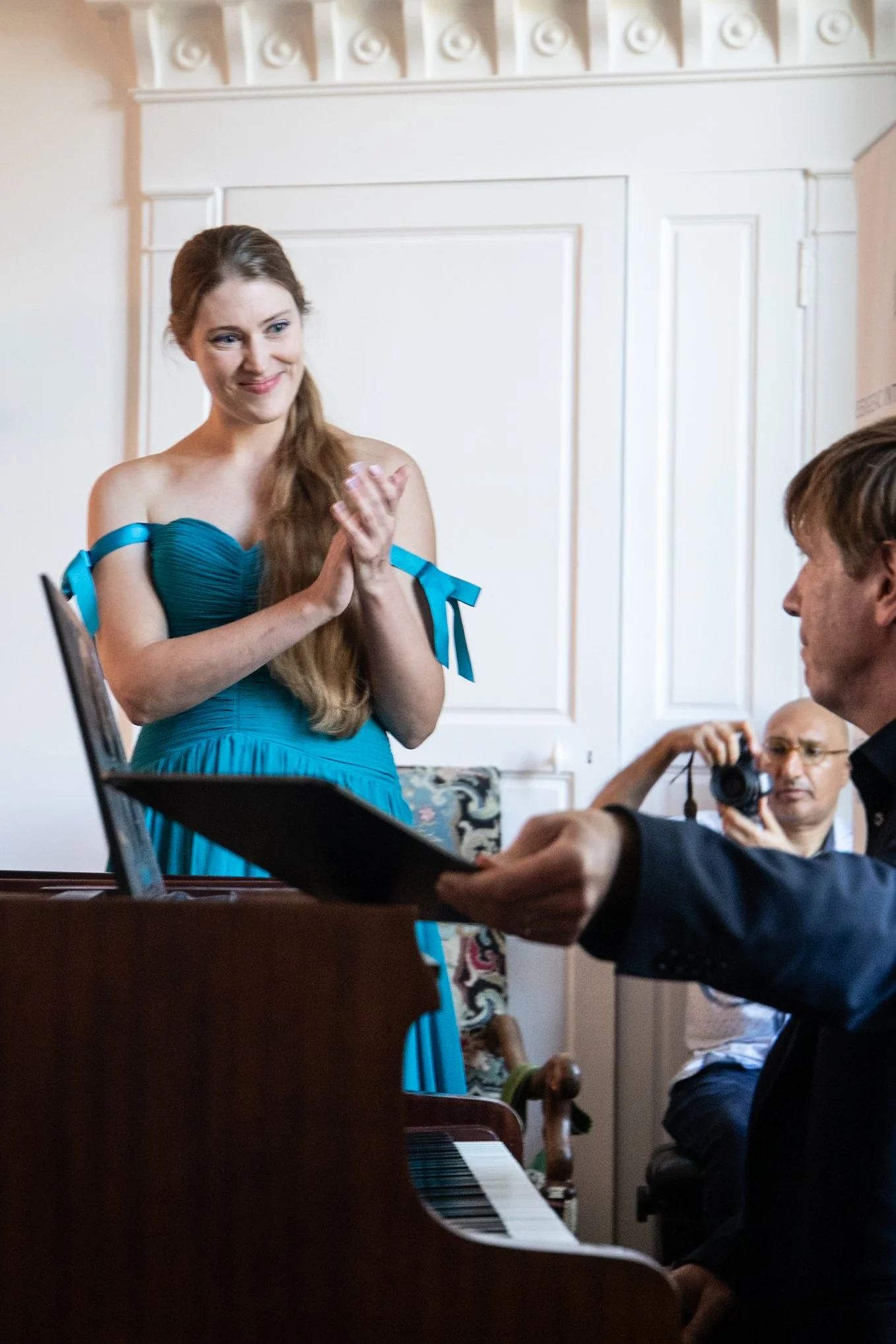
The art of listening
At the centre of much of the programme sat pianist Charles Matthews, born in London and raised in Bristol. He went to the Royal College of Music at seventeen, and was an organ scholar at Trinity College, Cambridge, a period he describes as ‘like being an apprentice.’ His first job was as a church organist, a post he held for two years while also running a choir; since then he has worked periodically across Spain, France and Italy as both pianist and organist, conducted a local choral society, performed for productions by the Royal Opera and the Royal Ballet, works as accompanist at the Royal Birmingham Conservatoire, and is Musical Director of the Campden Chorus.
His connection to Ishani goes back further than IIMA itself. The two first played together at a fundraiser for a trip to South Africa that Ishani had organised, and he was later drafted in as pianist for the following course, a choral course, when the Academy needed someone at the keyboard; he has been IIMA’s course pianist ever since. He had known Lizzie before Monboucher, and by his own account, playing together with her and Ishani is simply something all three of them love doing. The two singers had, in fact, already played with him the evening before the concert, so that by the time the doors opened on Saturday, the room already had the ease of people who had played together before.
At Monboucher, his presence initially appeared almost understated: while accompanying the singers, he gave them the foreground with remarkable grace. Yet sitting so close made it possible to see how active that apparent restraint really was. He listened, watched, anticipated; at moments it seemed almost as though he were building his hands around the next note the singer was about to produce. His body adjusted to theirs; the piano followed without ever feeling subordinate. There was humility in it, but not passivity.
Then came Fauré’s Deuxième Impromptu, and for several minutes thought about the article disappeared altogether. The man who had been carefully holding other performances together suddenly occupied the room entirely in his own right; his individuality as a musician became unmistakable. The solo also reset the rhythm of the afternoon, revealing just how much talent had been sitting quietly at the piano while attention belonged elsewhere. Ishani had deliberately programmed solo works for Charles for precisely this reason: she describes him both as a deeply accomplished collaborative pianist and as a formidable soloist, and wanted the audience to encounter the breadth of his musicianship.
Asked about his own musical identity, Charles admits the question is a hard one: he has spent so long playing such different repertoire that he seems to slip into different mental states depending on what is in front of him, “almost like having multiple personalities.” If there is a throughline, it dates to his teenage years, when he was captivated by the French tradition of organ playing from around 1870 onwards and dreamed, unrealised, of studying organ in Paris. A book on French piano music read around the same time left a similar mark. French music from the late nineteenth century on, he says, still feels like the repertoire in which he is most deeply rooted.
On what makes a successful musical partnership, he is equally direct. The starting point, he says, is that both musicians need enough musical and mental bandwidth to take real account of what the other is contributing: to be adaptable, considerate of a colleague’s practical needs, and able to work through moments when instincts do not quite align. Beyond that, it becomes a matter of building a personal understanding. Tellingly, he adds that some of his most successful partnerships have been with musicians almost nothing like him: a creative tension that can feel uncomfortable in the moment, but which he considers, on balance, a genuinely positive force.
By the end of it, the distinction between soloist and accompanist began to seem insufficient. Charles was doing something subtler throughout the afternoon: creating enough musical space for another person to become fully visible.
Evening Prayer
One late addition to the printed programme produced what became, for us, the emotional centre of the afternoon: the ‘Evening Prayer’ from Engelbert Humperdinck’s Hänsel und Gretel, sung by Lizzie and Anastasia.
We did not know the piece when it began, and perhaps that allowed it to arrive without expectation. The two singers stood together, and the contrast that had made their individual performances so compelling suddenly became a source of harmony. The intimacy between the voices was extraordinary: what had been separate, Lizzie’s sensitivity and Anastasia’s commanding theatricality, softened into something shared, their voices almost weightless, ethereal without becoming insubstantial. The room became still, and this was not one of those silences that feel merely like the pause before applause; for a moment, nobody seemed willing to disturb what had just occurred.
Only later did we understand the context of the piece: Hansel and Gretel, lost in the forest, offering their evening prayer before they sleep. Knowing that afterwards changed the memory. What had sounded tender acquired another language: protection, vulnerability, trust. And with two young musicians standing at the beginning of adult artistic lives, supported by people trying to create a structure around their talent, the resonance was difficult to ignore. We should not force symbolism onto music that does not require it. But some meanings seem to find their own way into a room.
The musician behind the institution
Throughout our time around the Academy, Ishani seemed to be everywhere: introducing people, rehearsing, ensuring seats were reserved, looking after guests and younger performers, always attending to some further detail. Then, towards the conclusion of the programme, she picked up her violin, and the change was startling. For the first time that afternoon, the administrator, organiser and mentor seemed to recede; what remained was the musician. Her command of the instrument felt instinctive, but there was nothing emotionally effortless about what emerged: the playing was intensely felt. One suddenly understood that the standards she asks of the musicians around her come from somewhere quite concrete: she knows what those standards feel like in the body.
In the final combination of voice, violin and piano, there was also an unmistakable trust between Ishani, Lizzie and Charles. The hierarchy between established musician and emerging performer seemed briefly beside the point; they were listening to one another. Ishani had described the closing work as particularly suited to Monboucher: intimate, evocative, capable of bringing voice, violin and piano together at the end of the evening. From less than a metre away, it felt closer to an exchange than a recital.
Ishani trained at the Purcell School and then the Guildhall School of Music and Drama before building a career as a professional violinist, playing with orchestras across the world, among them the Los Angeles Chamber Orchestra, the English Chamber Orchestra, the London Philharmonic Orchestra and Los Angeles Opera. Something of that range seems to sit behind the trust she places in Charles as a programmer: the singers chose what they wanted to sing, and having a pianist able to shape a programme around those choices, she feels, is a real asset.
What clearly matters most to her now is the mentoring itself. She speaks of enjoying the process of getting to know the young musicians who pass through her orbit, many arriving by way of masterclasses or orchestras, and of particularly valuing having them to stay with her, something she has only been doing for the past year, through a series of house concerts. She enjoys performing alongside them as much as guiding them. It is, she says, all a journey.
Lizzie, for her part, is unequivocal about what Ishani brings as a mentor.
When the final notes disappeared, the applause was enormous. And then nobody seemed particularly eager to leave.
After the applause
The distinction between audience and performer dissolved almost immediately. In the dining room, Champagne Robert Jaillant and local wine appeared alongside tomatoes and small plates of food, and conversation filled the house with the animated warmth one encounters so naturally around a French table. The musicians mingled with guests; the atmosphere turned celebratory rather than formal, and outside the windows the light was beginning to turn towards dusk. The house seemed happy.
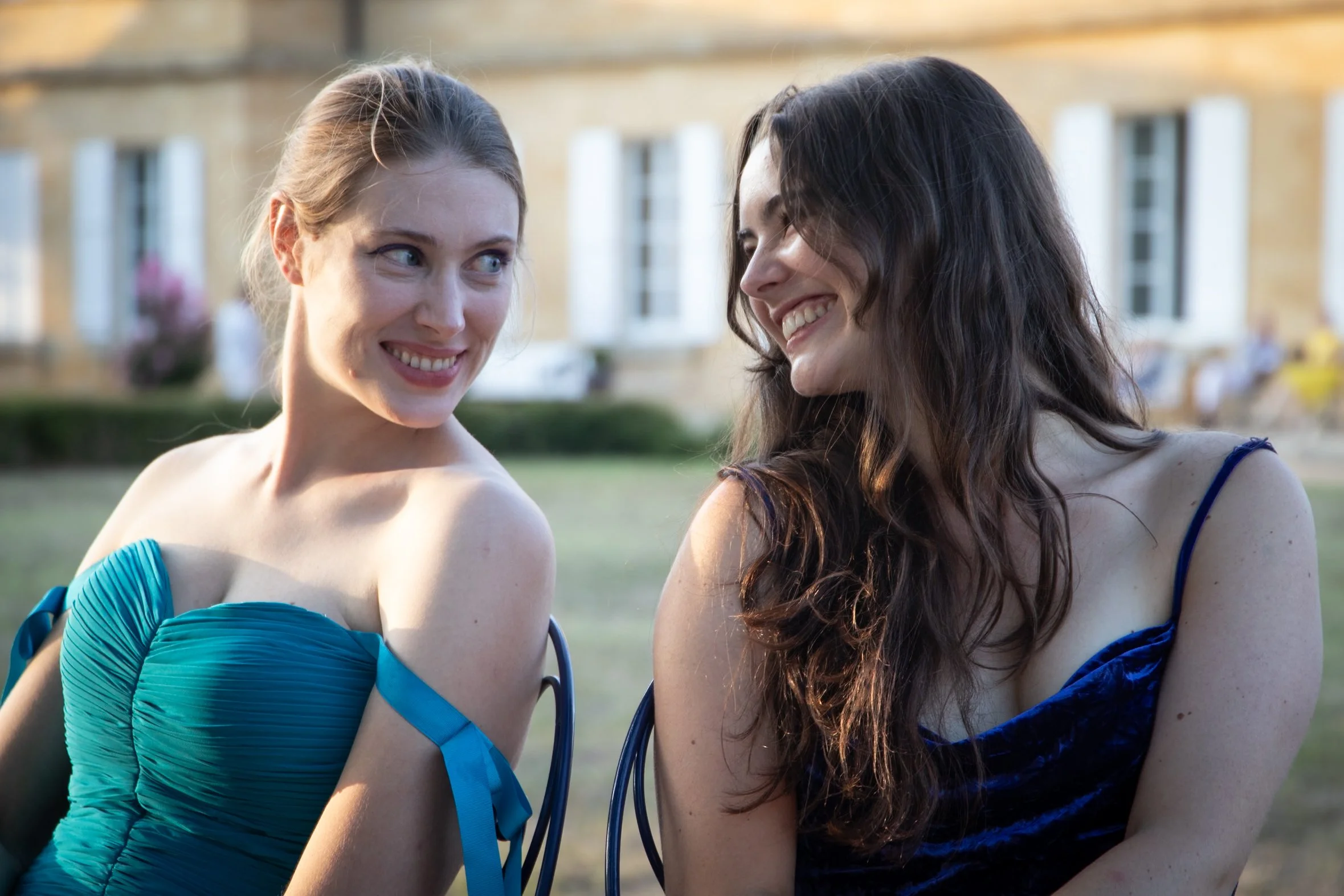
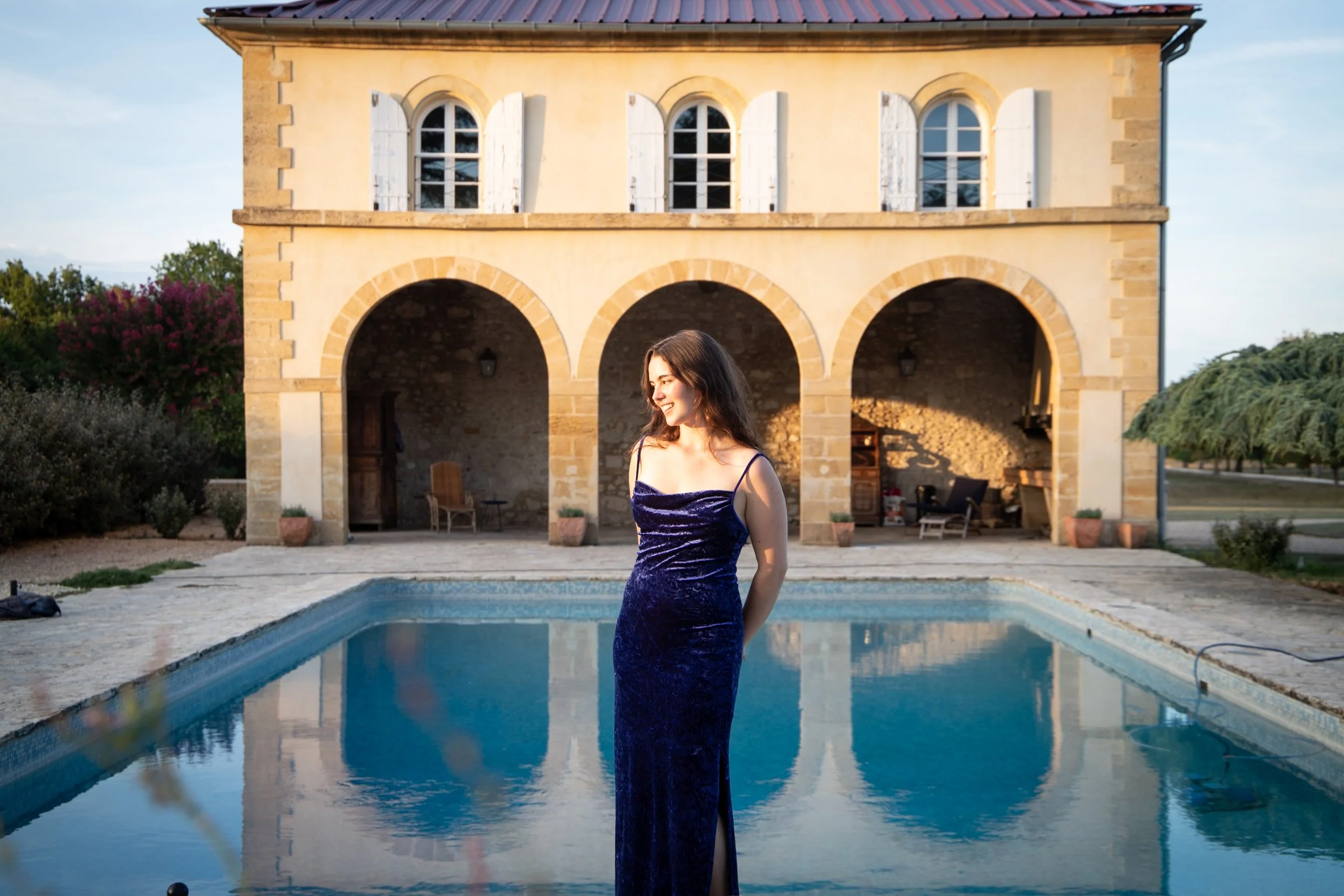
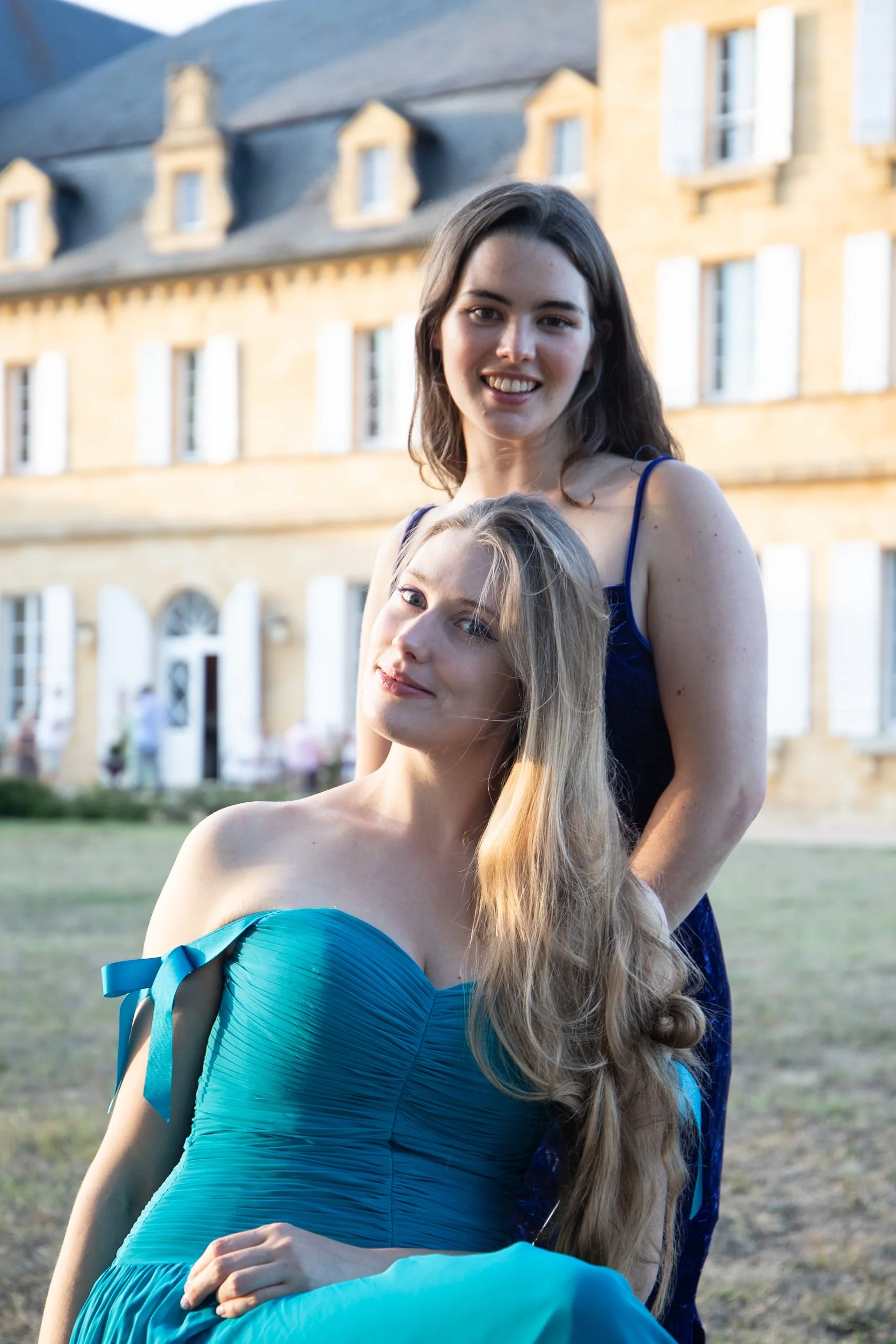
Then came one of the smallest moments of the afternoon, and perhaps one of the most revealing. Lizzie and Anastasia went outside to have photographs taken in front of the château. They were excited: not professionally pleased, not politely grateful, but visibly thrilled to have sung somewhere so grand. Watching them, all the larger vocabulary surrounding cultural institutions (artistic development, international exchange, mentorship, professional opportunity) suddenly became very simple. It came down, for a moment, to two young women who had been given a stage and wanted a photograph to remember it. Being given a stage matters. Being invited somewhere beautiful and trusted to fill it with your own talent matters. Being treated as a musician before your career has fully arrived matters.
What does an academy actually create?
Before visiting Issigeac, it would have been easy to understand IIMA primarily as an organisation that arranges concerts and masterclasses. Afterwards, that description felt inadequate. The Academy is trying to create musicians: not talent, which arrives with them, but the conditions in which talent becomes more certain, more disciplined and more capable of surviving: a teacher saying precisely what needs to improve, a professional pianist adjusting himself around your next note, a mentor checking on you after the course has ended, a real audience, a beautiful room, the expectation that you are capable of meeting the occasion, and then another performance.
Simon Jorda, the Academy’s Président, was especially pleased to see two of the girls back with the Academy after their masterclasses with Nelly earlier that year, precisely, he says, what IIMA should be about: building relationships with young musicians that continue after the course has finished, rather than ‘waving goodbye at the end of the week.’
Simon’s own account of his role is characteristically modest: his job, he says, is largely about making things happen, translating Ishani’s artistic vision and very high standards into something workable in the real world. His husband, Tony, heads up logistics and costings, so between them they can see what is practical and financially achievable, while Simon coordinates the artistic side, the logistics, the finances, the sponsorship, and everything else that goes into running the Academy: ‘there are rather more of those than you might imagine.’
Asked what sets IIMA apart from other music academies, Simon points first to scale: being small and personal, he says, is a huge part of it, and the beauty of Issigeac and the surrounding countryside becomes part of the whole experience. But he is careful not to let charm stand in for rigour: Ishani demands excellence, he says, and having musicians of the calibre of Nelly Miricioiu and Charles Matthews working with the Academy makes IIMA attractive to talented young musicians, who get an unusual amount of individual attention and access to people they might not otherwise reach.
Ishani’s language is similar. Former participants become part of what she calls the IIMA family, with returning musicians continuing their own development while encouraging those who follow them. Her longer view is more ambitious still: in five or ten years, she hopes some musicians who came to IIMA near the beginning of their careers might return not only as performers but as teachers themselves, handing what they have learned to another generation. That is cultural inheritance in its most practical form: one person teaches another, someone provides a room, someone pays for a bursary, someone opens a door, someone listens seriously, and years later, perhaps, the person who was invited through that door becomes the one holding it open.
Long after we are no longer in the room
What began to emerge over the course of the evening was therefore something larger than the success of one concert. The importance of an academy such as IIMA cannot ultimately be measured by who happened to sit in a château salon on a particular August afternoon. Audiences disperse, young musicians move to other stages, teachers eventually hand their knowledge to somebody else. What matters is whether a structure remains capable of finding talent, challenging it, giving it a stage and allowing one generation of musicians to encounter the next.
In that sense, Musicians of Tomorrow is not simply an appealing title for a fundraising evening; it describes an act of cultural continuity. The artists we heard were already musicians; what they were being given was the possibility of becoming more fully themselves as musicians. This is why support for an organisation such as IIMA matters beyond those of us fortunate enough to have been at Monboucher. The task is not merely to preserve the memory of one beautiful evening once we are no longer in the room. It is to make certain there can be another room, another audience, another teacher, and another musician whose name none of us yet knows.
The cost of possibility
Beauty requires remarkably practical support. Saturday’s gathering was in aid of both IIMA’s wider artistic programme and its Bursary Fund. Funding is needed not merely for bursary places but for the teaching, courses, concerts and professional opportunities that make those bursaries meaningful; the Fund has so far enabled six young artists to take part in Academy programmes.
The reality beneath a performance such as Monboucher is therefore less romantic than the setting might suggest. Young musicians need money to train. Teachers need to be brought in. Venues are required. People need somewhere to stay. Pianos need moving, programmes printing, audiences finding. The slow work of forming an artist is expensive, even when much of the organisation surrounding it is given voluntarily.
Regular sponsorship offers something more valuable than merely balancing a budget: it creates room to plan, to offer bursaries and to attempt projects that might otherwise be judged too financially uncertain. Talent may be exceptional while the structures supporting it remain fragile, and that is one reason evenings such as Monboucher matter even beyond the funds raised on the day.
Simon puts it in more practical terms: sponsorship is absolutely vital, and really that was what Saturday evening was all about. Regular funding, he says, is what lets the Academy plan ahead with confidence, support young musicians through bursaries and, importantly, try things: developing courses and projects that might otherwise be judged too great a financial risk. ‘If we have a solid base of support behind us, we can be much more adventurous.’
Ishani said beforehand that success would also mean guests leaving moved by the musicians, with new relationships beginning: future supporters, sponsors, advocates and audiences. Those relationships are themselves cultural infrastructure.
A place becoming part of an Academy
There is another reason IIMA increasingly interests us: it does not feel like an academy that simply happens to have selected a picturesque corner of France as its address. Issigeac is becoming part of what the Academy is. Ishani is explicit about that distinction:
As IIMA grows internationally, she believes its roots in the local community must deepen at the same time: local people should be able to experience the Academy as something belonging to them too, whether through concerts, volunteering, hosting musicians, supporting its work, or simply encountering international artists in their village.
That ambition already extends to the built heritage of Issigeac. The Academy currently uses several performance venues around the area, often through the generosity of organisations providing their spaces without charge, and its longer-term ambition is to establish a permanent base at the Palais des Évêques, currently undergoing restoration. For IIMA, the attraction is not simply grandeur: a permanent home would allow the Academy to build programmes and audiences while becoming a more visible and enduring part of village life, and there is even the possibility that the restored Palais might become a wider cultural hub, shared with other organisations and contributing to the artistic life of Issigeac and the surrounding area.
After Monboucher, that idea did not feel abstract. Historic buildings survive most convincingly when they are given something to do; a château filled with voices is different from a château merely admired, and a restored Palais filled with young musicians would be different from one merely preserved. Perhaps that is what we had already sensed at Monboucher: a house experimenting with continuity rather than stasis, its historic fabric allowed to coexist with contemporary art, new inhabitants and new uses.
Simon felt something similar the first time he arrived in Issigeac: something rather magical about the place, he says, the age and quaintness of the buildings making you want to wander around and discover what’s there. He would like IIMA’s students to feel something of the same thing during their time with the Academy: that they have discovered somewhere special, and want to come back. ‘It’s a beautiful and cute place,’ he adds, simply.
His ambitions for IIMA are, in their way, modest. He would like a steady programme of events and courses running through the year, and for the Academy to become well known and respected in musical circles, but not at the cost of what makes it distinctive. ‘I certainly don’t want us to become corporate,’ he says, hoping instead that the Academy can grow while remaining small, personal, ambitious and very much part of Issigeac. That, he says, is when they will have got it about right.
Preservation matters. But continuity asks another question: what are we preserving something for?
Across the Channel
The Franco-British dimension of IIMA could easily become institutional language. At Monboucher it felt considerably simpler: a predominantly French audience, a French language teacher introducing the programme, visitors arriving from Britain, a Paris-born soprano from a Russian family, musicians whose training and careers have crossed borders, music written across Italy, France, Germany, Austria and Russia passing through the same salon. Ishani hopes that, eventually, people might think less in terms of ‘British musicians’ and ‘French musicians’ and instead see a community of artists connected by a shared passion for music.
The following morning, this was the thought that remained. Politics is exceptionally good at articulating the gaps between people; culture is often better at showing how naturally those gaps can be crossed. That does not necessarily require a formal act of diplomacy. Sometimes it is Albert Croce standing in a room in the Dordogne, moving easily between language and music. Sometimes it is Charles Matthews listening carefully enough to shape his playing around a young singer’s next note. Sometimes it is two emerging sopranos standing beside one another in an eighteenth-century château, singing a German evening prayer. And sometimes it is sixty or so people drinking full-bodied red wine after the final note because none of them particularly wants the afternoon to end.
We live in a time when cultural institutions on both sides of the Channel are under pressure, when the slow work of forming an artist can seem less urgent than the next digital distraction. Evenings like this one push gently against that. They remind us that a Franco-British conversation is not only about policy or trade; it is also about shared aesthetic inheritance: the same scores, the same disciplines of listening and craft, the same need for places where young musicians can meet mentors and audiences who take them seriously.
We had arrived at Monboucher for a concert in aid of the Musicians of Tomorrow. We left understanding that tomorrow is not something culture reaches automatically. It has to be taught. It has to be housed. It has to be financed. It has to be practised. And, above all, it has to be believed in.
The question that lingered as we finally drove away from Monboucher was simple and practical: how do we better sustain this? Comment mieux soutenir cela ?
Not with grand declarations, but with attendance, with word of mouth, with the decision to return, to bring others, to treat the work of the Academy as part of the living cultural fabric that connects France and the English-speaking world. The task now is to make certain that the musicians who will inherit what we presently hear (here, and elsewhere) are given the same opportunity to continue, long after we are no longer in the room.
We left with the sense that a small bridge had been crossed, un petit pont avait été franchi, not a formal alliance, just the beginning of a relationship between people who care about the same things. In a château that has already outlived many generations, that felt like a beginning worth protecting.